 Dark Ages Re-Creation Company




It is always better to make a furnace well in advance of the burn, but in this case timing didn't work out. This lead to the construction of the Mark IV oval being built on the day of the melt and it being built of Straight clay.
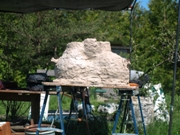
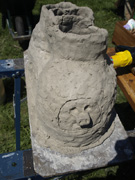
The base is a 30x60cm oval matching one of the bases found at Ribe. This style can be set with two working ports - one on each short side. The port for the bellows is in the center of the long side. At the top are two chimneys with another pot for annealing between them.
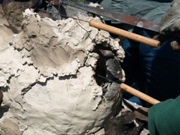
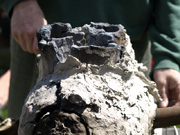
The wet clay was heated to dry and sinter it, then the bead making began. Almost immediately the serious nature of the cracks forming became visible. This is a weakness both of straight clay and of running a furnace that is still too wet. We added more clay to help with the cracks but it got so bad that we were losing pieces of wall. So we stopped the run.
 |
 |
 |
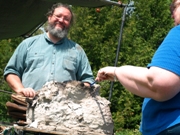 |
| Side view | End view | Visible cracks | Building a bead |
 |
|||
| Massive cracking |
Not wanting the day to end we decided to try a new design. Trine, the bead maker at Ribe had shifted to using a furnace modelled on the circular furnace base found at Ribe.
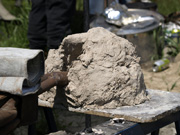
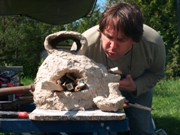
This furnace uses a burn chamber (the lower portion) and a small chimney at the top to allow the heat out. This chimney has a covered working area to allow the bead maker the work. On the side is a charcoal chute and annealing crucible, and a port for the air from the bellows.
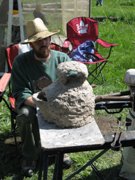
This time we chopped some straw to mix in with the clay producing a much stronger cobb. Not being sure of working over the small chimney we added a small working door in the one side.
 |
 |
 |
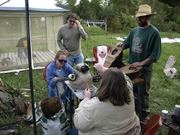 |
| Building teapot | Lighting teapot | Drying | Making beads |
The teapot furnace was interesting enough that we decided it would be worth trying a second one at our next opportunity. This style is really only suited for a single beadworker at a time and the smaller workspace is more suited to a more experienced worker.
For both furnaces the upper surfaces are a guess as there are no archaeological remains I am aware of other than a few pieces of sintered cobb from Ribe that were found on top of one of the bases - that may be remains of the walls of a furnace.

